|

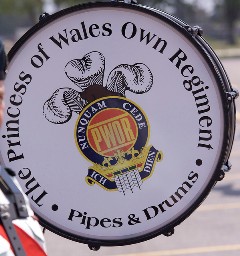
The Princess of Wales’ Own Regiment
is a Reserve infantry regiment located in
Kingston, Ontario. The unit was organized on
January 16, 1863 as the 14th Battalion
Volunteer Militia Rifles of Canada from the
amalgamation of Kingston’s seven independent
rifle companies with lineages dating back to
the War of 1812. In 1868, shortly after the
wedding of the Prince of Wales (later Edward
VII) to Princess Alexandra of Denmark, the
Regiment was granted permission to use the
name 14th Battalion, The Princess of Wales’
Own Rifles.
During
the Fenian Raids of 1864 and 1866, when
Irish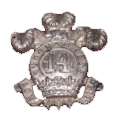 extremists operating out of the United
States conducted forays into British North
America, the Battalion was called to active
duty at Niagara and, later, Cornwall. In
1885, during the Riel Rebellion, the PWOR
was activated for garrison duty at Tete du
Pont Barracks (now Fort Frontenac) and Fort
Henry.
extremists operating out of the United
States conducted forays into British North
America, the Battalion was called to active
duty at Niagara and, later, Cornwall. In
1885, during the Riel Rebellion, the PWOR
was activated for garrison duty at Tete du
Pont Barracks (now Fort Frontenac) and Fort
Henry.
In
1899, members of the Battalion volunteered
to serve in the Boer War. As a result of
their substantial contribution, the unit
received the South Africa battle honour, and
in 1900, was raised to “regimental” status.
At
the outbreak of war in 1914, the unit
contributed men to the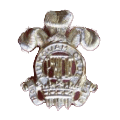 2nd Battalion CEF, 1st Division. At the same
time, the 21st Battalion, CEF was formed in
Kingston with large contributions from the
Regiment. The unit also contributed officers
and men to the 59th, 146th and 253rd
Highland Battalions. After the war, the 14th
Regiment (The Princess of Wales’ Own Rifles)
was re-designated a line infantry regiment
so that it could carry the battle honours
and colours of the 21st Battalion, CEF on
parade (a rifle regiment traditionally
carrying its battle honours on its drums).
The unit adopted its present designation,
The Princess of Wales’ Own Regiment, in
1921.
2nd Battalion CEF, 1st Division. At the same
time, the 21st Battalion, CEF was formed in
Kingston with large contributions from the
Regiment. The unit also contributed officers
and men to the 59th, 146th and 253rd
Highland Battalions. After the war, the 14th
Regiment (The Princess of Wales’ Own Rifles)
was re-designated a line infantry regiment
so that it could carry the battle honours
and colours of the 21st Battalion, CEF on
parade (a rifle regiment traditionally
carrying its battle honours on its drums).
The unit adopted its present designation,
The Princess of Wales’ Own Regiment, in
1921.
For
the Second World War, a decision was made
not to mobilize the Regiment for overseas
service owing to the heavy losses suffered
in the First World War. Instead, the
regiment provided one complete company to
the Stormont, Dundas and Glengarry
Highlanders. It also provided a guard for
Prisoners of War held at Fort Henry. In June
1942, the 1st (Reserve) Battalion PWOR was
organized for domestic service at Sherbrooke,
Quebec and Debert, Nova Scotia, where it was
de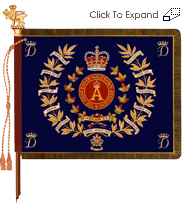 ployed
for east coast defence. ployed
for east coast defence.
In
1985, Diana, Princess of Wales became the
Colonel-in-Chief of the Regiment, a title
she held for 11 years. In recent years,
members of the Regiment have distinguished
themselves on overseas tours in Cyprus, the
Former Yugoslavia and Afghanistan.
The Princess of Wales’ Own Regiment
Lineage
The 14th Battalion Volunteer Militia Rifles,
Canada – 1863
14th Battalion, The Princess of Wales' Own
Rifles – 1868
14th Regiment, The Princess of Wales' Own
Rifles – 1900
The Kingston Regiment (The Princess of
Wales' Own) – 1920
The Princess of Wales’ Own Regiment – 1921
Motto:
Nunquam Cede – Never Surrender
Music
March: The Buffs
Allied With:
Duke of Lancaster's Regiment
Perpetuating:
Battalion of Incorporated Militia of Upper Canada
1st Regiment of Addington Militia (1812-15)
1st Regiment of Frontenac Militia (1812-15)
1st Regiment of Lennox Militia (1812-15)
21st Overseas" Battalion, CEF
59th Overseas" Battalion, CEF
253rd Overseas" Battalion, CEF
The Battle Honours of the
Regiment
NIAGARA
The War of 1812 (Defence of Canada), 1812-1815
South African War, 1900
World War I: SOMME, 1916, '18; Flers-Courcelette; Thiepval;
Ancre Heights; ARRAS, 1917, '18; Vimy, 1917,
HILL 70; YPRES, 1917; Passchendaele;
AMIENS; Scarpe, 1918; Drocourt-Quéant;
HINDENBURG LINE; Canal du Nord; CAMBRAI,
1918; PURSUIT TO MONS; FRANCE AND FLANDERS,
1915-18.
World War II: Honorary Distinction - The badge of
the Stormont, Dundas and Glengarry
Highlanders, with the year-dates 1944-1945.
AFGHANISTAN |


 The
Governor General's Horse Guards
(GGHG)
is a reserve regiment of volunteer citizen
soldiers whose illustrious history dates
from 1822 when
The
Governor General's Horse Guards
(GGHG)
is a reserve regiment of volunteer citizen
soldiers whose illustrious history dates
from 1822 when
 After
the Boer War, a new Cavalry Regiment was
formed in Toronto later named the
Mississauga Horse. During the First World
War, both the Mississauga Horse and the GGBG,
supplied thousands of volunteers to the
Canadian Expeditionary Force in France.
After the war, both Regiments were privilege
to perpetuate the elite 4th Canadian Mounted
Rifles (4th CMR) history and battle honours.
The 4th CMR, raised by the GGBG and
Mississauga Horse, were the most heavily
decorated Battalions of the Canadian Army,
including a Victoria Cross earned by Pte TW
Holmes at Passchendale. In 1936, the
Mississauga Horse and the GGBG amalgamated
to form the Governor General's Horse Guards.
The new Regiment activated for overseas duty
in 1940, saw action in Italy and
subsequently, Northwest Europe, receiving
nine battle honours for distinguished
performance in World War II.
After
the Boer War, a new Cavalry Regiment was
formed in Toronto later named the
Mississauga Horse. During the First World
War, both the Mississauga Horse and the GGBG,
supplied thousands of volunteers to the
Canadian Expeditionary Force in France.
After the war, both Regiments were privilege
to perpetuate the elite 4th Canadian Mounted
Rifles (4th CMR) history and battle honours.
The 4th CMR, raised by the GGBG and
Mississauga Horse, were the most heavily
decorated Battalions of the Canadian Army,
including a Victoria Cross earned by Pte TW
Holmes at Passchendale. In 1936, the
Mississauga Horse and the GGBG amalgamated
to form the Governor General's Horse Guards.
The new Regiment activated for overseas duty
in 1940, saw action in Italy and
subsequently, Northwest Europe, receiving
nine battle honours for distinguished
performance in World War II. The
Regiment has been serving Canada as a
reserve regiment continuously since World
War II. It was in 1941 that the regiment
lost its horses to become a mechanized
regiment of tanks. The Regiment remained
Armoured until 1965 when it was tasked as a
light Recce Regiment in jeeps. The Regiment
converted back to an armoured regiment with
the Cougar Armoured Car in 1982. In 1950,
the GGHG provided 50 volunteers for duty
with the Special Service Force in Korea.
Individual volunteers and small groups have
served with Canadian NATO contingents in
Europe and on peacekeeping operations
worldwide. Horse Guards continue to this day
to volunteer for service
augmenting the Regular Army.
The
Regiment has been serving Canada as a
reserve regiment continuously since World
War II. It was in 1941 that the regiment
lost its horses to become a mechanized
regiment of tanks. The Regiment remained
Armoured until 1965 when it was tasked as a
light Recce Regiment in jeeps. The Regiment
converted back to an armoured regiment with
the Cougar Armoured Car in 1982. In 1950,
the GGHG provided 50 volunteers for duty
with the Special Service Force in Korea.
Individual volunteers and small groups have
served with Canadian NATO contingents in
Europe and on peacekeeping operations
worldwide. Horse Guards continue to this day
to volunteer for service
augmenting the Regular Army.


.jpg)
.jpg)
.jpg)
.jpg)
.jpg)